Optimizely Onramp
A marketer's best first personalization campaign, before they knew they needed one.
Whoever buys personalization is rarely the one who runs it.
Optimizely sells personalization alongside its A/B testing product, and most accounts buy the two together. A marketing leader signs the contract, and running personalization falls to a marketer who never asked for it, usually whoever is left holding the account.
Your VP of marketing or your CMO… we basically talk them into the vision.
80%to85% of personalization accounts are bundled with a web experimentation product rather than bought standalone.
Optimizely's own field assessment.
Who signs it
A marketing leader
Signed for both products
Who runs it
A marketer who never signed anything
Handed both products
One contract · two products included
- Web Experimentation
- Web Personalization
Signed
492 accounts paid for personalization in June, and only 58 did anything with it.
I turned the brief around. The team of four had been asked to build something with AI agents, and I wanted to know what was broken first.
Those accounts are paying for personalization, and the marketers holding most of them are not using it. Nothing in Optimizely asks a marketer to start.
- 492
- accounts paying for personalization, June 2026
- 58
- did anything with it: created an audience, or ran a qualifying campaign
Optimizely's own analytics.
Marketers on completely different tools were stuck for the same three reasons.
I expected the problem to be inside Optimizely's own product.
Ten in-depth interviews
Six subject-matter experts
They see across many accounts.
Four marketers
They personalize somewhere else entirely.
I just don't know what to personalize.
I was wrong. The experts and the marketers gave back the same reasons, and not one of them was about the tool they were using. Nobody knew when to start.
They mainly did not understand it.
They did not think they had the data for it.
Once they reached the results, they could not tell whether it had worked.
People overthink it and don't just start.
I put the first campaign where marketers already worked.
I put a nudge to start on the Optimizations page, next to their A/B tests. Getting to the personalization tab is its own decision, and nobody was making it. Left there, the nudge would only have reached marketers who had already decided to go.
I like what y'all are doing… people are not going to be living inside Opal. They're going to be inside here.
Optimizations
Suggested for you
Treat returning visitors differently.
- ~58% of this week’s sessions, up from ~40%
- 0 of 6 experiments treat them differently
Takes under 10 minutes
| Name | Type | Status | Modified |
|---|---|---|---|
| Autumn-quarter homepage hero CTA | A/B Test | Running | Jul 18, 2026 |
| Course-catalog search redesign | A/B Test | Running | Jul 15, 2026 |
| Financial-aid form length | A/B Test | Running | Jul 12, 2026 |
| Apply-now button copy | A/B Test | Paused | Jul 10, 2026 |
| Giving-page donation ask | A/B Test | Running | Jul 7, 2026 |
| Tuition-page layout | A/B Test | Not Started | Jul 3, 2026 |
I showed each account which campaigns it could run that day.
I sorted the campaigns by whether the account already held the data each one needs. A nudge toward a campaign it could not run would have been one more place to stop. Marketers believed they did not hold enough, and that belief is false for many campaigns and true for others.
I don't have a CDP so I can't do it.
Ready to launch
Campaigns you can launch now
Welcome back offer
Uses data you already have
A few steps away
Campaigns that need one setup step
Program-page revisit
Needs program-page view tracking
Grows with your data
Campaigns that unlock when you turn on a signal
Engaged-visitor nudge
Turn on program-page view tracking, no developer
Where a campaign needs something installed, the marketer hands that step off first, instead of finding out when they try to publish.
Install the snippet
The snippet is the one-time script that lets your campaigns show on your site. Once it’s on, everything you set up here goes live.
- Opal
Opal drafts the snippet for your site.
- about 10 minutes
You: paste it into your site’s header.
Not your job? Send it to whoever manages the site.
Hide the noteShow a note you can send
Hi! We’re setting up Optimizely personalization on our site. Could you paste their one-time snippet into the site’s header? It’s about a 10-minute job. Opal drafts the exact code and checks that it’s working once it’s in – nothing shows to visitors until we launch a campaign.
Copy it into an email or chat – whoever manages the site can take it from there.
- Opal
Opal checks that it’s firing and lets you know.
How much work is this going to take to get going… that was a really good unlock.
I had not designed the results page, and a month later I could not read it.
I had not aligned the team on it either. I signed off on its words without checking the rule the agents had written into its spec. The rule said personalization has no statistical significance, so never give a verdict. Now I read the rule before the words.
I am very confused about this. How do I know if my personalization campaign made me money or not?
I changed the rule
“Tell the manager if it worked or not.”
The last design of the results page
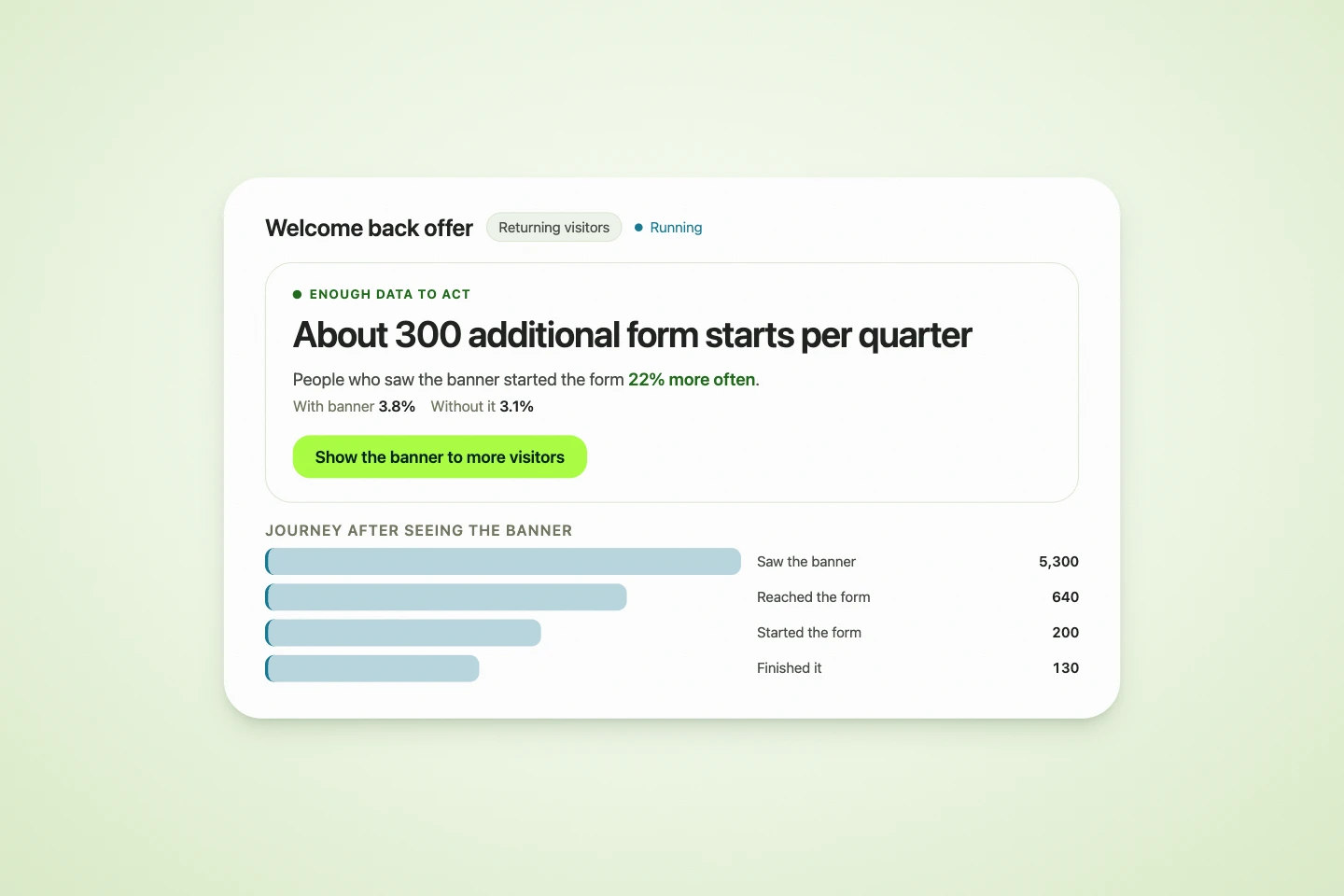
About 300 additional form starts per quarter
People who saw the banner started the form 22% more often.
- With banner
- 3.8%
- Without it
- 3.1%
Did it work?
Yes, it did work.
That rule only holds for small audiences. I turned the page into a verdict, one line the marketer can repeat to their boss, even when there is not enough data yet. Under it I put the path that produced it, so the marketer can check it.
Journey after seeing the banner
12% clicked through
31% started
65% finished
I don't know that they would report yet, or basically just say, hey, there's not been enough visits to be able to determine anything.
3:02The band as it read before 48,210 and the percentage came out of it.
Four people and a set of agents, and the hard part was agreeing.
I built the knowledge base that the four of us and the agents all worked from, and I ran every merge myself. It is the first thing I would build again.
Alignment is a document someone owns, not a meeting everyone attends.
Four people can agree out loud and still be holding four different plans.
I wrote the plan down only after we had already disagreed. The next time it came up nobody argued with me. They went and read it.
Agents produce work faster than anyone can form an opinion about it.
A decision that turned out fine is not the same as a decision anyone reasoned through, and at this speed nobody notices the difference.
So I stopped reviewing what the agents produced and started reading the specs they worked from, which is where the decision had already been made.
Stakeholders commit to a problem they can retell, not to a solution they were shown.
An advisor said it back to me unprompted: you're brand new to the business, the old person who ran it left, you're picking it up. That's so real for us.
What I would design next is the campaign nobody nudges you into.
I scoped Onramp to the first campaign because that is where the problem was. Optimizely committed to building it. The second campaign starts differently: nobody hands it to you, and Onramp only starts when Optimizely spots an opening in the experiments a marketer already runs.
82%
of accounts that launch a first campaign go on to launch three or more.
From an internal Optimizely product requirements document, May 2025.