Phantom
A tool so the best ideas stop dying in bad presentations.

Designers in my program kept losing the room with decks that had no clear story
When classmates in my design program presented, I often couldn't tell where the deck was going, and I could see people losing the thread. Their ideas needed buy-in, and a hard-to-follow story didn't earn it.
In AIGA's 2021 survey, designers ranked presenting among their five largest skill gaps. I built Phantom for them.
The same content, on slides headed by the claim, was explained better and remembered better ten days later.
My bet was an AI agent that writes the story and hands you a finished deck
If the story got lost, I wanted the AI to tell it. ChatGPT could already draft each slide's headline, subtext and visual idea, and I still copied every piece in by hand. So I bet an agent could place each piece itself.
The agent, a hand-drawn ghost, got many layouts wrong, and I didn't count that as a problem. I wanted the AI to decide what the deck should be.
A wrong number looks like a right one, and it goes to your boss under your name
I tested with someone in finance, a project manager and a product manager, because their work runs on data. A bad layout was easy to change, so they let it go. Their own data coming back mushed and made up, they did not.


Checking every number yourself is the work Phantom was meant to save. I hadn't counted the AI's mistakes as a problem, and for the ones people could see and fix, they weren't.
I kept the AI off their numbers, so every chart drew straight from the file
I let the AI decide what each chart should answer, such as a comparison, a ranking or a trend, and which rows it needed. Code picked the chart from that answer and drew every value from their file exactly as they gave it.


My rough demo still amazed my cohort, so I kept building with the AI I had
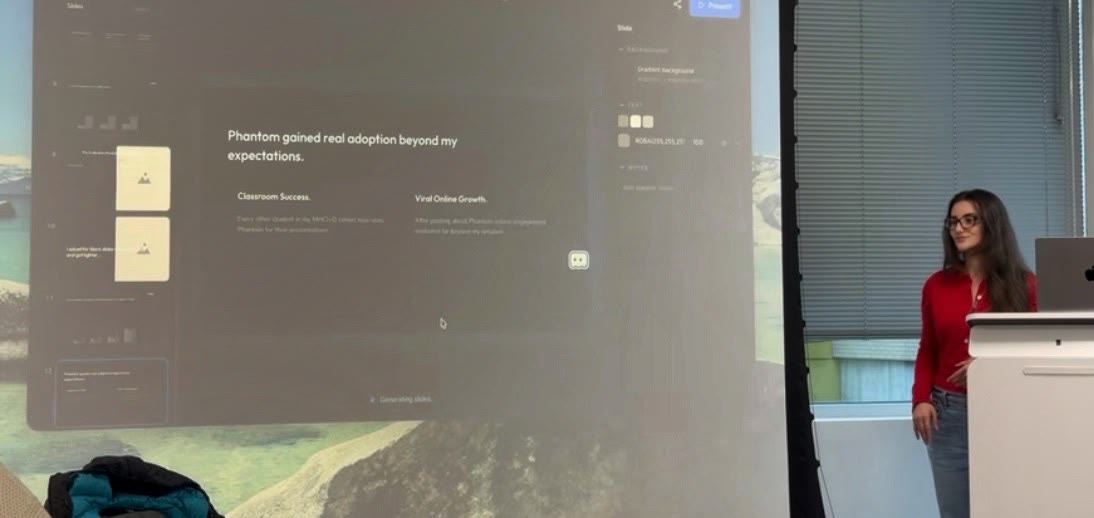
I showed it to about 45 people in my cohort while it still mixed up parts of the story. People were amazed by what it could do, and some came up afterwards to ask for the link.
My AI repeated my classmates' mistake and finished the deck before the story
I heard in testing that the deck felt locked. One participant found that once a deck was generated, the story was hard to change or even see in detail. Fixing it meant working inside finished slides, and they said it took so many edits it was almost not worth it.
Safer numbers didn't solve that problem, because people still met the story only after the slides were built. The deck said what the AI decided before anyone could shape it, just as my classmates' decks had.
I put an outline before the slides, so people and the AI settle the story first
I built the outline the way I make my own decks, writing the text before designing anything. The arc sits on top as one editable sentence, and the agent asks its questions before generating.
You rewrite, reorder, change what kind of slide a card becomes, or tell the agent what to change. There are always going to be edits, so the outline puts them where the story is still cheap to change.
Designers feared AI making things up, so I made the ghost a teammate you guide
I think an AI gets things wrong the way a person does without clear direction, and designers weren't giving it any.
You retype, move, restyle and crop anything yourself, the way you would in any design tool. Or drop the ghost on a headline or a slide and type what to change, like leaving a teammate a comment. On a whole slide, it can rebuild the layout.
The AI got the layout, and people kept the story and their own numbers
I heard from participants that their stories got clearer once they could fix them with the agent. I saw the same in my own decks. Settling the story first also cut the time each deck took.
Time to make one of my decks
3 hours to 1 hour
Cohort using Phantom
35 of 45
Hours self-reported from my own decks. Users from the app’s data at the time.
Three reflections
Showing uncertainty only helps if people can fix it where they see it.
The ghost flagged charts still holding sample data, and wrong assumptions reached the slides anyway.
I would hold the facts tight and give the layouts room to vary.
One set of instructions held the rules for every type of deck, and its strict layouts made decks look the same.
Now I would give the story and the visuals their own agents, and keep both off the numbers.
People trust an AI one task at a time, by what they expected of it.
People expected to change the layout anyway, and expected their own numbers back exactly as they gave them.